Duke of Buckingham
George Villiers, the Duke of Buckingham, is the most dazzling and dangerous figure in the European power struggle that frames The Three Musketeers. As the all-powerful favorite of two English kings, he is driven by a consuming, reckless love for Queen Anne of Austria, a passion that sets him against Cardinal Richelieu, precipitates a war between England and France, and ultimately leads to his assassination. Buckingham is the novel's great romantic antagonist—a man whose personal desires reshape the fate of nations, and whose death marks the tragic climax of the story's political and emotional arcs.
Identity and Introduction
Buckingham is introduced not in person but through the whispered scandal of the French court. The Musketeers, in the antechamber of Monsieur de Treville, speak of him with a mixture of awe and contempt, noting that he is in France and that his presence is linked to the queen . Athos, in a rare moment of admiration, declares him "worthy of being loved" and says he never saw a man with a nobler air . He is described as immensely rich, all-powerful in a kingdom he disorders at his fancy, and at thirty-five, the handsomest gentleman and most elegant cavalier of France or England . His wealth is legendary; at a ball at the Louvre, Porthos picks up two pearls the duke scattered, selling them for ten pistoles each . Buckingham is a man who lives by his own rules, certain that the laws which govern other men cannot reach him .
The Queen's Love and the Cardinal's Rivalry
Buckingham's consuming passion is for Queen Anne of Austria. He first saw her three years before the novel's main action, and he has loved her with an intensity that neither time, absence, nor despair can extinguish . He recalls every detail of their first meeting: her green satin robe embroidered with gold and silver, her hanging sleeves, her large diamonds, and the heron's feather in her cap (E01445-E01446). He has seen her only four times in those three years, and each meeting is a diamond he encloses in the casket of his heart . Their most intimate encounter was in the gardens of Amiens, where for one instant he was alone with her, feeling her hair touch his cheek . The queen, though terrified of the scandal, confesses that the influence of the place, the charm of the evening, and the fascination of his look nearly destroyed her . This love is the secret engine of the plot: Buckingham undertakes the expedition to the Isle of Re and the league with the Protestants of La Rochelle solely for the pleasure of seeing her again, even if thousands of men must pay for his happiness with their lives . Cardinal Richelieu, who also loves the queen and is Buckingham's rival, sees the duke's presence in Paris as a direct threat to his own power and to the king's honor . The cardinal's plot to expose the queen's gift of the diamond studs to Buckingham is the central crisis of the first half of the novel.
The Diamond Studs and the Journey to England
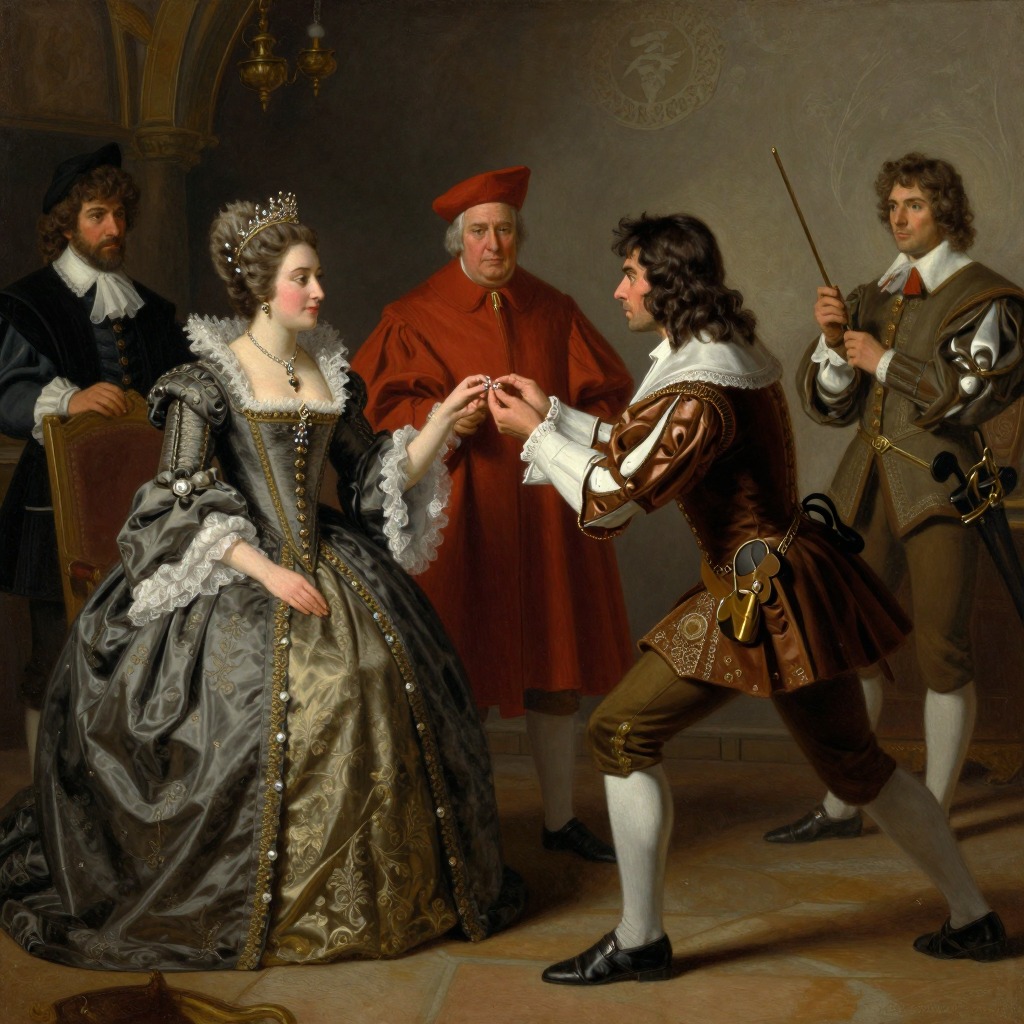
Buckingham's role in the affair of the diamond studs reveals both his romantic devotion and his capacity for grand, theatrical gestures. The queen, having given him the twelve diamond studs given to her by the king, is forced to demand their return to avoid exposure at a royal ball . When d'Artagnan arrives in London with the queen's desperate letter, Buckingham is at Windsor hawking with the king . Upon reading the letter, he is overcome with emotion, turning pale and fearing he might faint . He immediately takes d'Artagnan to a secret chapel in his palace, where a full-length portrait of Anne of Austria hangs over an altar, and where the casket containing the studs is kept . He kneels before the portrait as a priest would before a crucifix, and declares he had sworn the studs would be buried with him . When he discovers that two of the twelve studs have been stolen—cut from the ribbon by Milady, acting on the cardinal's orders—he is devastated (E02642-E02644). He immediately places an embargo on all vessels in English ports to prevent the stolen studs from reaching France before the replacements can be made (E02660-E02662). He then imprisons his jeweler, Mr. O'Reilly, in the palace to create perfect replicas within two days, paying him three thousand pistoles apiece (E02670-E02677). This extraordinary exercise of power, all for the sake of a queen's favor, demonstrates the fusion of his personal passion with the authority of a state minister.
The War with France and the Final Crisis
Buckingham's love for the queen is the direct cause of the war between England and France. He admits to d'Artagnan that Anne of Austria is his true queen, and that upon a word from her, he would betray his country, his king, and even his God . He has already broken his promise to send assistance to the Protestants of La Rochelle because she asked him not to . The cardinal, in his instructions to Milady, reveals the depth of his knowledge of Buckingham's secrets: the duke's costume as the Great Mogul at the Constable's ball, his disguise as an Italian fortune-teller to enter the Louvre, and the details of the Amiens garden adventure (E05564-E05568). The cardinal threatens to publish these scandals, and if the duke persists in his war, the cardinal hints at the need for an assassination, recalling the knife of Ravaillac that killed Henry IV (E05582-E05586). Milady, having been given this mission, seduces the Puritan fanatic John Felton, convincing him that Buckingham is the Antichrist and the ravisher of her honor (E07040-E07042). Felton, believing himself an instrument of God's justice, stabs the duke in his own cabinet at Portsmouth . Buckingham's last moments are consumed by his love for the queen. As he lies dying, he receives a letter from her, delivered by her faithful servant Laporte, begging him to abandon the war and to watch over his life (E07346-E07348). He asks if she has sent any other message, and Laporte tells him she charged him to say that she still loved him . With this, Buckingham dies in peace, bequeathing to Laporte the silver casket containing the queen's letters and the knife that killed him, as a final memorial (E07359-E07361).
Thematic Significance
Buckingham is the embodiment of romantic chivalry in its most dangerous and self-destructive form. His love is absolute, transcending politics, loyalty, and even self-preservation. He is a force of nature, a man whose personal desires can move armies and topple governments. Yet he is also a tragic figure, aware of his own impending doom. He tells the queen he has had a presentiment that he will die shortly, and she confesses she has dreamed of him lying bleeding, wounded in the left side with a knife (E01460-E01464). This premonition, shared between them, binds their fates together and gives their love story an elegiac quality. Buckingham's death is the novel's great turning point: it removes the immediate threat of English invasion, allows the siege of La Rochelle to succeed, and frees the cardinal to pursue his domestic enemies. But it also leaves the queen in permanent mourning and cements the legend of a love that was both the ruin and the glory of all who touched it.